
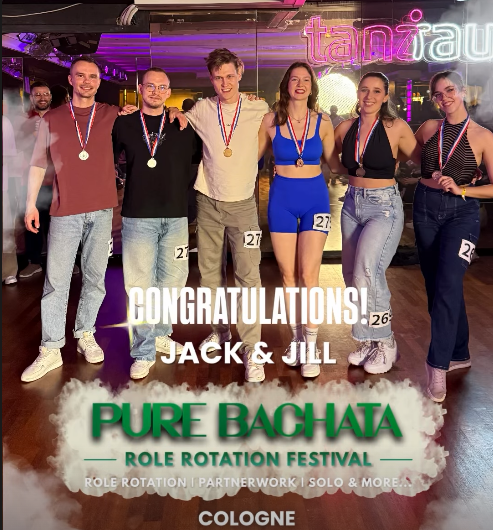
RoleRotation Bachata competitions have a particular kind of magic. They are fast, vulnerable, energising, and a little bit chaotic in the best way. They ask something different of you than social dancing does, and every time I step into one, I walk away having learnt something new.
Here are five things that keep showing up for me.
1. It’s my favourite time to dance
There is something electric about the room during a RoleRotation competition. Everyone is dancing at their peak. Not perfect, but present, focused, and all in.
You meet so many dancers in such a short space of time. It feels a bit like speed dating on the dance floor, except instead of small talk you get to dance your favorite way nonstop. I have met people I may have never found on a social floor.
It reminds me why I love dance in the first place. Not for performance, but for connection.
2. Winning isn’t everything, but not winning can still hit
We say winning isn’t everything, and that’s true. And also, not winning can still sting.
Competitions act like a stress test. They show you what you can do under pressure, how you show up when your nervous system is loud, and what slips when the stakes feel high. So many things shape the outcome. Your partner, the music, the order, the judges, the energy in the room, how you recover when something goes wrong.
This is different to social dancing. Performance matters. Presence matters. How you adapt in the moment matters.
Sometimes the result reflects your growth. Sometimes it doesn’t. But if you are willing, open and able it will always teach you something, regardless of the outcome.
3. Working with your partner is everything
RoleRotation makes one thing very clear very quickly. Your job is not to shine over someone else. Your job is to work with the person in front of you.
Can you adapt to different bodies, different styles, different levels of experience? Can you listen without controlling? Can you offer clarity without force? Can you recover together when something doesn’t land?
Some of the best dances are not the flashiest ones. They are the ones where both people feel seen, supported, and safe enough to take risks.
That is a skill. And it reaches far beyond competition floors.
4. Mindset shapes the experience more than the score
Each competition can feel like a benchmark. A moment to measure where you are now compared to the last one.
That can be motivating. It can also be misleading.
The people around you are growing at different rates, with different access to training, different bodies, and different life constraints. Your result is not a ranking of your worth or even your overall ability. It is a snapshot of how you performed that day, in that room, with those songs and those partners.
When I stop being comparative, everything shifts. My body and mind relaxes, my listening improves. I take more risks. And the dancing usually gets better too.
5. It’s a balance of skill, effort, and a lot you cannot control
RoleRotation competitions sit in an honest tension between preparation and chance.
Training matters. Musicality matters. Body awareness matters. The work you put in shows. And also, there are elements you cannot control. A random partner. A random song. A moment where connection doesn’t quite land.
That doesn’t make the experience meaningless. It makes it human.
For me, the value is not in treating the result as a final verdict, but as information. What felt solid? What felt shaky? What do I want to explore next?
A question I keep coming back to
Is competition good or bad for our community?
I don’t think the answer is simple.
One thing I genuinely appreciate about RoleRotation competitions is how they showcase the practice itself, not just the outcome. They make visible that both roles matter. That listening is a skill. That adaptability is something you learn, not something you are born with. Even when the dancing is messy, the message is clear. This floor is not owned by one way of moving.
The support in the room matters too. People cheering for dancers they do not know. Partners offering encouragement after a tough round. Shared laughter when things go wrong. That culture does not happen by accident. It happens because people choose it.
When encouragement is normalised, competition stops feeling like a threat and starts feeling like a shared challenge.
If competition becomes the only measure of value, we lose something. If it becomes a space for exploration, visibility, and shared growth, it can add something meaningful.
At its best, RoleRotation reminds me that growth is uneven, connection is central, and care does not disappear just because there is a score sheet.
That feels worth holding onto.
Written by Christine Walsh from the Door Forward

