
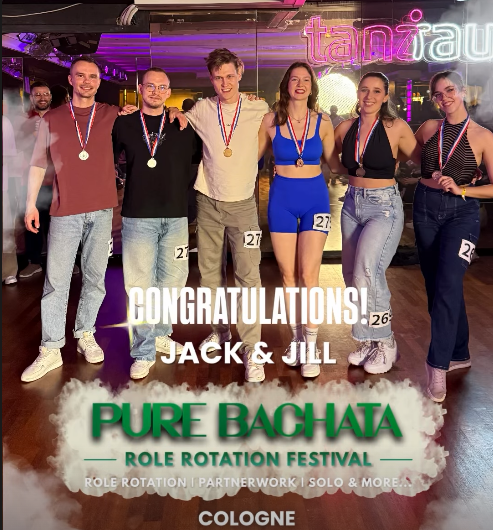
This weekend in Cologne, during the Pure Bachata Role Rotation Festival, there was again a public competition floor where dancers were allowed to dance both roles.
A Jack & Jill competition floor where dancers could show up as they actually dance.
They could:
- lead and follow,
- rotate roles at any moment,
- choose how initiative was taken and shared,
- and compete using the full range of their skills.
No role assignment.
No gendered structure.
No need to adapt to fit the format.
The format adapted to the dancers.
How it functioned
This RoleRotation Jack & Jill was integrated into the festival program like any other competition.
People entered the floor knowing they would not be limited to a single function.
They danced under pressure.
They improvised.
They made decisions in real time.
Nothing was slowed down.
Nothing was simplified.
Nothing was “made easier”.
They competed at full intensity, with full responsibility.
The dancers on the floor
The finalists were:
- Carmen & Cat
- Christine & Myriam
- Ronja & Gilles
- Max & Collin
- Alena & Laura
Each pair brought their own way of navigating role rotation.
Different dynamics.
Different choices.
Different solutions.
No one danced “the same way”.
No one was asked to.
In the finals, the dancers judged each other.
Dancers who had just been on the floor, under the same conditions, evaluated the round.
Not from the outside.
Not through fixed-role expectations.
From inside the experience.
For transparency, the final order was:
- Ronja & Gilles
- Max & Collin
- Carmen & Cat
- Alena & Laura
- Christine & Myriam
As always, the order is documented.
But the existence of the floor is what matters.
Why this keeps being relevant
Not because it’s the first.
Not because it’s exceptional.
Not because it needs defending.
But because it keeps happening.
Every time a floor like this exists:
- it becomes less remarkable,
- less dependent on explanation,
- less questioned.
Competitions stop deciding who belongs.
They stop acting as gatekeepers.
They turn into what they actually are: containers.
And containers matter while they are needed.
About this competition floor
This RoleRotation Jack & Jill was part of the festival program and functioned like any other competition space.
The difference was simple and visible:
dancers were allowed to dance both roles.
They were not assigned a function.
They were not restricted in how roles were used.
They were not asked to adapt their dance to fit a fixed structure.
They danced, competed, and made decisions in real time using the full range of their abilities.
This was not presented as a concept.
It was simply how the floor operated.
That’s it.
No hierarchy.
No lesson.
No future claims.
No private intent exposed.
This was one more space where dancers could show up this way, in public, without explanation.
